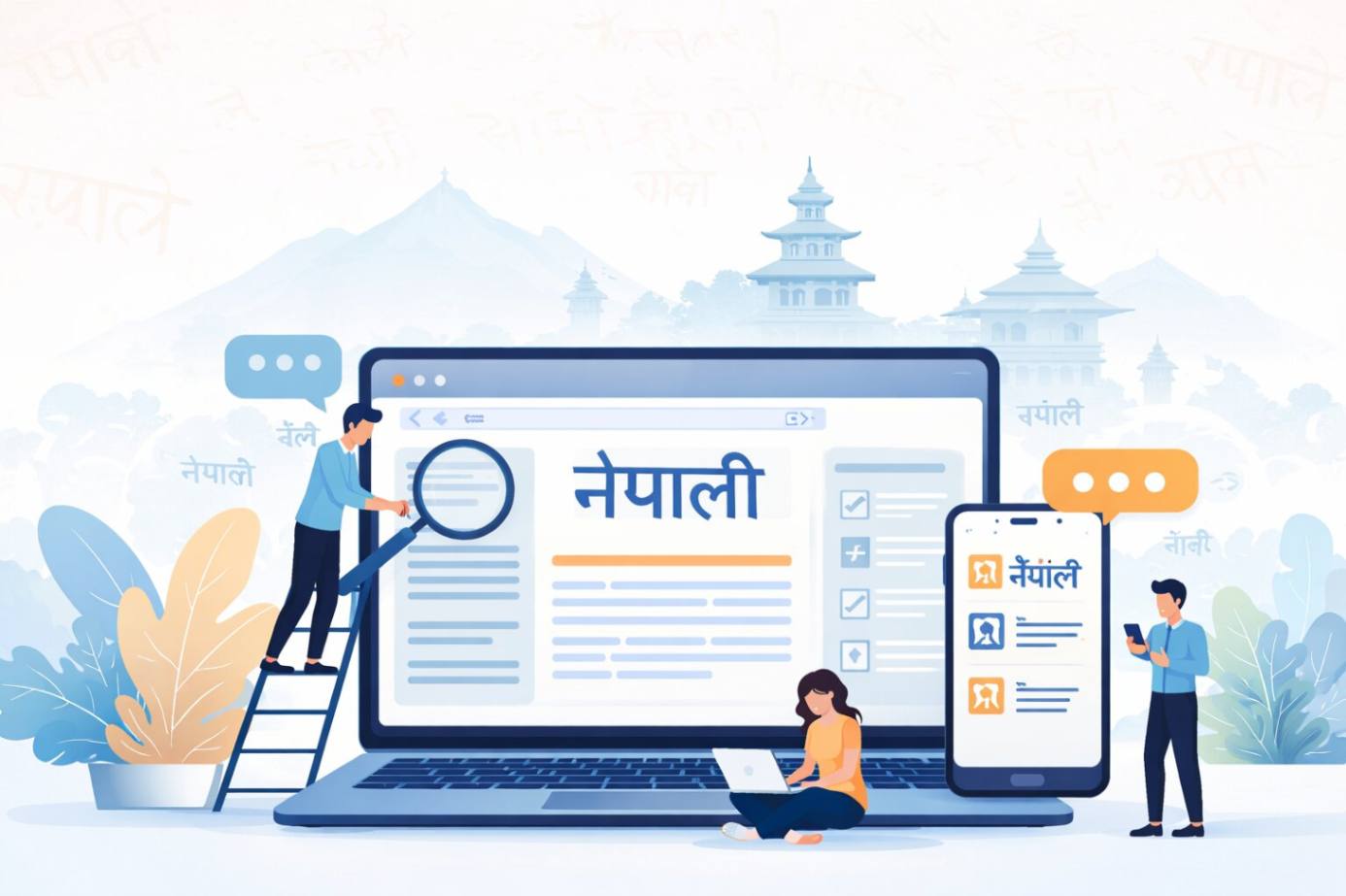
A website in Nepali language matters greatly in today’s digital ecosystem. Language is more than a medium of communication; it works directly on user trust, cultural identity, and engagement. The presence of a website in the language of Nepal can serve not just for translation, but for most internet users in the country who might read the language they speak. The website can therefore serve as an important link between local businesses and the rapidly growing number of internet users in the country. Research has shown that users are more likely to be comfortable with, and take action, on websites they read in a language they understand better, and therefore, an important aspect for internet use in the country.
Nepal is quickly going digital. Millions of people access the web through mobile phones, social media, and local sites, yet many websites still struggle to render Nepali text correctly due to improper fonts and poor typography.
This guide will describe the relevance of Unicode, present evidence-based observations, and share the best ways to make your Nepalese website readable, professional, and SEO-friendly.
Why Building a Website in the Nepali Language Is Extremely Important?
Now, before discussing font and typography, it’s essential to understand the importance of Nepali-language sites in contemporary times.
A Growing Digital Population in Nepal
Nepal’s internet landscape is expanding quickly:
- According to datareportal, by late 2025, about 16.6 million Nepalis were using the internet, which is 56 % of the total population, and this number continues to grow each year.
- Mobile connections outnumber people; there were 32.4 million mobile connections, more than the population itself, showing how deeply mobile phones are embedded in Nepali life.
- Nepal’s digital scene also shows around 14.8 million social media accounts, which is about 50 % of the population actively online.
These figures tell us one thing clearly: Nepali users are online, active, and ready to engage with digital content. If your website does not speak Nepali well, you risk losing connection with a huge audience.
Even though internet access has grown rapidly, there are still disparities. For instance, only 39.7% of households in the country at large have internet access, while urban centres such as the Kathmandu Valley have a significantly higher proportion than rural areas. This is to say that your website in Nepali language shall assist in connecting new internet users for the first time in accessing the www.
The Reality: Language on the Web
The global web is still dominated by English. Research shows that English is used on nearly 47 % of all websites worldwide, making it the most common online language. In comparison, Nepali appears on only a very small fraction of web content, estimated at close to 0 % among the top one million websites globally.
This gap reveals an important truth. While millions of Nepalis are active online, very few websites truly serve them in their native language. Most Nepalese are left with no option but to view in English. Even Nepali will seem much more comfortable.
This poses a gigantic opportunity for businesses and organizations in Nepal. When you create a website in Nepali language, you automatically gain a competitive edge.
This automatically enables you to create a stronger connection with the people. In the digital world, Nepali content is minimal. A website in Nepali language is not only helpful but also a plus point.
What Is Unicode?
Unicode is the modern standard used to represent computer text internationally. The principle behind Unicode is assigning every character in the computer world its own number so that any text can be viewed on any computer or browser that is supported by its software. Unicode is able to write thousands of scripts and languages; its own is the Devanagari language of Nepal.
Why Unicode Matters for Nepali Websites?
Before Unicode was the standard, many Nepali users and writers used Preeti, Kantipur, Sagarmatha, and Himal legacy fonts, among others. These fonts were popular because they would appear correct on local computers only if those fonts were installed on a computer.
However, legacy fonts use proprietary encoding, which causes big problems online:
- The text may look like a jumbled representation as it is displayed in systems that lack the same fonts.
- Browser search engines fail to index the Nepali texts properly for effective SEO.
- Screen readers and accessibility tools fail to interpret the text, making the content inaccessible to visually impaired users.
- The content may not display properly in mobile phones or in the newer browsers, which require Unicode encoding.
The majority of contemporary browsers and operating platforms now support Unicode. The implication is that Unicode character-based texts will now be visible without any need to download fonts.
How does Unicode solve these problems?
Here are the actual advantages of using Unicode on your website in Nepali language:
- Universally Compatible: Text looks the same on all types of computers, mobile phones, and tablets, and does not require the installation of fonts.
- Search Engine Indexing: Unicode text is readable and indexable to search engines, resulting in higher rankings in search engine results.
- Accessibility: Your content for the visually impaired, as well as others with the inability to view images, can be made possible through the assistive technologies that support the Unicode text format.
- Future-Proof Content: Unicode helps future-proof your content by ensuring that your text is always readable and maintainable
Real‑World Example
For example, if you want to type “नमस्ते,” which is the word for “hello” in Nepal, in your website content. However, if you use a font that is not Unicode, such as “Preeti,” the text may not be rendered correctly on most computers. However, if you type “नमस्ते” in the Unicode system, then everything will appear in perfect font and style in Windows, Mac, Android, or iOS devices or browsers.
This is why Unicode has been the behind-the-scenes secret to making readable texts possible on the internet. This is because, without Unicode, Nepali texts, for instance, will become almost impossible to read.
Best Practices for Unicode Fonts on Your Nepalese Website
Now that you are clear on why Unicode is so important, it’s high time that we introduce you to some real font recommendations and typographical advice that make a world of difference.
1. Pick Unicode‑Compatible Nepali Fonts
Studies conducted by major browsers and operating systems highlight the fact that the most reliable rendering is offered by Unicode fonts. In the case of Nepali websites, the use of fonts designed for Unicode and the web will help in the proper display and readability of texts.
Recommended Unicode Fonts for Nepali Websites:
- Noto Sans Devanagari: These fonts have been developed by Google and support 800+ languages and are optimized to run well in all browsers, like Chrome, Firefox, Safari, and Edge.
- Kalimati: It is among the Nepali Unicode fonts most often used, which works on Windows, Android, and web platforms.
- Mangal: It is a Devanagari Unicode font that comes pre-installed in most Windows platforms and is thus applicable to web design.
These fonts are fully supported on Windows, MacOS, Android, and iOS browsers, so your Nepali contents are viewed properly by almost 100% of the audience.
An inclusion of Unicode fonts in CSS helps your website with the Nepali language show up correctly:
body {
font-family: “Noto Sans Devanagari”, “Kalimati”, sans-serif;
}
Do not use fonts that are not Unicode, such as Preeti or Kantipur fonts. Even if your font is very attractive on your own computer, it will appear improperly on other users’ computers.
2. Use Appropriate Font Sizes & Line Spacing
Typography is more than type. It also has to do with how comfortable the text is to read:
- Body text: 16px or slightly higher
- Line height: 1.4–1.6× the font size
- Headings: proportionally larger
This helps in ensuring the text is not too dense or too spaced out, especially in the case of mobile phones, where most Nepali Internet users are connected to the Internet.
3. Use Fallback Fonts
You should always include fallback options in your font stack. An example might be:
font-family: “Kalimati”, “Noto Sans Devanagari”, Arial, sans-serif;
That means if the device of the particular user doesn’t support the Nepali font, it will fall back to another readable font like Arial, increasing readability and trust with the user.
4. Limit Font Families for Better Performance
An excess of fonts will slow your site, especially for those with slow Internet access. Nepal’s mobile‑first audience can suffer from large webpages.
Best practice: Two font families at most: one for headings, one for body text.
This ensures that your Nepalese website loads and reads well.
Other Typography Tips to Boost UX
- Clear Visual Hierarchy
Make headings of consistent size (H1, H2, H3), so that the audience understands what matters most in the content. This helps retain the audience.
- Proper Line Length
The length of a line should be around 50-75 characters per line. This helps ease the strain on the eyes and improves understanding of the texts, especially longer Nepali texts.
- Contrast Is Key
Ensure your font colour provides better contrast with the background colour. This is especially important for readers who are older or reading under reduced lighting.
- Responsive Typography
Use relative units like em or rem in CSS to scale text for different screen sizes:
html {
font-size: 100%;
}
h1 {
font-size: 2rem;
}
This ensures your website in Nepali language is readable on phones, tablets, and desktops alike.
SEO Benefits of Nepali Unicode Text
If you’re planning a Nepalese website that shows up in search engines such as Google, you’ll need Unicode content:
Search Engines Can Read Unicode Text
Google and Bing support the indexing of Unicode text. This implies that Nepali keywords such as “नेपाली वेबसाइट” or “website in Nepali language” will show up in the result.
Proper Metadata
Remember to use title tags, descriptions, and alt text, all written in Unicode Nepal, so your site shows up correctly in search engine previews.
Example:
<title>Nepali Language Website Development</title>
<meta name=”description” content=”नेपाली भाषामा तयार गरिएको वेबसाइट, responsive design, छिटो लोड हुने संरचना र search engine friendly समाधानसहित।”>
Tools to Help Write Nepali Online
These are some tested tools which can help in the easy preparation of Nepali Unicode content:
- Nepali Unicode Converter Tools
There are tools where you type in Romanized Nepali (such as “Ramro Article” and it magically gives “राम्रो आर्टिकल”
- Nepali Keyboard Support
Including Nepali keyboard support for Windows, macOS, and mobile platforms, one can directly enter the texts in Unicode.
- Online Editors
There is support available for typing in Nepali Unicode on platforms such as Google Docs if the language settings allow for it.
These tools enable you to write neat and correct Nepali text for your site.
Real‑World Examples: Nepali Language Online
Examples of Nepalese websites making effective usage of Unicode and Nepali fonts:
- OnlineKhabar: Amongst the most viewed news websites in Nepal, available in Nepali and English. Utilizes Unicode text for writing news, titles, menus, and metadata.
- Annapurna Post: This is a publication that has transitioned to becoming online, utilizing Unicode Nepali texts for better accessibility and search engine optimization.
- Herne Katha: Popular online documentary series releasing Nepali-language stories through Unicode text.
These examples show how native language content combined with quality typography is crucial for upping engagement, trust, and brand.
Common Pitfalls to Avoid
- Using Preeti or Legacy Fonts: These don’t render correctly on many devices, and they break SEO.
- Long Paragraphs Without Breaks: This makes reading Nepali text tiring. Always use paragraphs and bullet points.
- Ignoring Mobile Users: Over half of Nepal’s internet users browse via smartphones. A site that isn’t mobile‑friendly loses half its audience.
- Not Testing Across Devices: Make sure your text looks good on all of those desktop, tablet, and smartphone screens.
Cultural Relevance: Connecting with Nepali Audiences
Nepali content creation is more about translation of words; it deals with culture, traditions, and values. When a website has a culture-friendly interface, it attracts more visitors.
To make your Nepalese website Culturally Relevant:
- Use local idioms and common phrases: speak in a way as if you were speaking to a Nepali audience.
- Incorporate visuals of Nepali life: You will need to include pictures of the land, festivities, and other activities that people do in Nepal.
- Adopt a relatable tone: Strive to make the tone professional as well as warm, so as to connect emotionally with the audience.
A site that demonstrates an understanding and respect for the Nepali culture will strengthen the bond with your visitors since it will encourage them to identify, trust, and return to your site.
Step-by-Step Guide to Launching a Nepali Website
Starting your online presence for Nepalese sites needs to be done with careful planning and functionality.
Here’s how you can go about it to make sure that your newly designed Nepalese website is professional, inviting, and search engine-friendly right from the outset:
Step1: Planning
Identify the target audience for your website, the purpose it will serve, and the type of content you will provide.
Step 2: Font Selection
Unicode-compatible fonts like Noto Sans Devanagari or Kalimati will help texts appear properly on all devices.
Step 3: Content Creation
Prepare articles, headings, and meta descriptions in Unicode Nepali, keeping readability and SEO principles in mind.
Step 4: Design
Prioritise mobile-first design, clear visual hierarchy, and readable typography.
Step 5: SEO Optimization
Include Unicode keywords, meta tags, alt tags, and internal linking to improve search engine visibility.
Step 6: Testing
Ensure that the website can be accessed via a computer, tablet computer, smartphones in a range of browsers.
Step 7: Launch & Monitor
Once a site has gone live, one needs to monitor analytics & user feedback. Also, content needs to be optimized.
By following a structured approach in this manner, there is a guarantee that your site in Nepal is visually impressive and also accessible and optimized to provide a smooth experience to the user.
Final Thoughts
Words themselves do not define language but rather trust, identity, and association. Seeing content in your local Nepali language in a readable format helps create instant association with your Nepalese website.
An online presence for your business that is also accessible to people speaking the Nepali language not only provides information but also provides a digital home for your business. It will help your business stand out among other competitors.
Focus on Unicode fonts, typographies, and a mobile-friendly design that ensures every visitor sees your content as you intended it-readable, engaging, and meaningful. For the people of Nepal, this will show that you care about what they want, which, in some ways, could be the deciding factor for someone who might be a casual user versus a regular user.
🚀 Ready to Start?
Create your professional Nepali website today, simple, readable, and SEO-friendly.
Contact Smart Web Care Centre now!
Recent Posts
-

Website Development Is Not a One-Time Project: Why Ongoing Support Matters
May 01, 2026 | admin
-

Website in Nepali Language: Best Practices for Unicode Font & Typography
Mar 02, 2026 | admin
-

Website Redesign Checklist: When & How to Redesign Your Nepal Website
Feb 08, 2026 | admin
-

Email Marketing in Nepal: Complete Guide to Build & Engage Your List
Jan 18, 2026 | admin
-

SEO Audit Checklist 2026: 30+ Points to Improve Your Nepal Website
Jan 16, 2026 | admin
-

Facebook Ads vs Google Ads in Nepal: Which Delivers Better ROI?
Jan 11, 2026 | admin
-

Content Marketing Strategy for Nepal: From Zero to Authority in 90 Days
Jan 09, 2026 | admin
-

WooCommerce vs Shopify in Nepal: Which E-commerce Platform Is Better in 2026?
Jan 05, 2026 | admin
